Top Tips for First Time Buyers

first-time-buyer

So, you’ve decided that now is the time to take the plunge and set your feet firmly on the property market by buying your first home.

Though buying property can be an exciting time for many, it can also be a daunting experience and will be one of the largest financial commitments you will make in life.

So what kind of issues should you be considering when house-hunting?

1. Know your budget

It is important before you get going to seek the advice of an independent financial adviser to find out how much of a mortgage you could be given by a lender and how much of a balance you will have to pay towards the property from your own savings.

A deposit of around 10% of the house price is normally required but the more you can put down to begin with, the better the mortgage deal you will be able to get.

Be realistic about your lifestyle after you move into the property and don’t overstretch yourself in your monthly mortgage commitments. Remember you will also have other outlays before you get your keys such as legal fees, additional surveys, mortgage product fees and stamp duty so be sure to figure them into your budget along with any costs for redecorating and furniture.

2. Research! Research! Research!

It’s a little odd that we make a commitment to spend a very large sum of money based on a quick walk round a property, possibly with other potential buyers present.  When you are viewing a property you like, ask as many questions as you can;  When was that sunroom built?  Does it have planning permission?  Is there a warranty?  Who are your neighbours?  Who owns that massive tree overhanging the garden and who is responsible for trimming it?

Get a second viewing of the property and consider commissioning your own survey – remember, a survey carried out for mortgage purposes is for the bank’s protection, not yours.

If you don’t already live in the area, then visit the location at several different times of the day and night, weekday and weekend.  The character of a neighbourhood can really change depending on the time of day. Check the amount of rates payable for that area. Check out local schools, transport routes and sports facilities. Ask yourself; “Is this somewhere I really want to live?”

3. Be aware of ‘common areas’

Many new developments and apartment blocks will have common areas containing stairs, lifts and common recreational space.

All apartments should have the benefit of a management company who look after the maintenance and insurance of common areas – this is also common in many new developments.

The weeding of all those flowerbeds isn’t cheap and so to maintain and insure the common areas of a development or apartment block, each resident is required to pay an annual service charge to the company managing the development or apartments.  This charge may be over £100.00 per month and in some developments substantially more. The estate agent showing you around the property should be able to give you an idea of the service charge before you place your offer. Ask yourself can you afford this as well as your other outgoings.

4. Make yourself an attractive purchaser

Demand for property is now strong and you want to have the competitive edge if you are bidding on a new home. The key to this is being prepared:-

  • Have a mortgage agreement in principle in place – this is a document from your chosen lender saying they are happy to lend to you.
  • Have proof that you have the deposit monies in your bank account.
  • Return calls to the estate agent promptly.

Showing that you are keen and engaged can go a long way to securing your property. Speak to a solicitor in advance and know who you are going to appoint to represent you in the purchase of the property

Above all else, don’t get caught up in the excitement and either over-commit yourself financially, or end up in a property you like, but don’t love. Take your time to make the right choices to ensure that in the end, there really is no place like home.
Happy house hunting!
RFlinnRuth Flinn is a solicitor in the Property Law department of Francis Hanna & Co Solicitors.                                                  If you require any further information on buying a house or if you would like a free no-obligation quote, please contact Ruth on rflinn@fhanna.co.uk

SmallLogo

The Office Christmas Party: Jingle Bells or Alarm Bells??

office-partyMary Gavin, Associate Solicitor in the Employment Law department of Francis Hanna & Co Solicitors has provided us with this guest blog on some steps employers should take to ensure an incident-free Christmas party _____________________________________________________________________________________

As the festive season fast approaches, many employers and employees look forward to enjoying a Christmas dinner with colleagues ……at the expense of the boss!

Most parties pass off without incident, (perhaps the odd blush) but others can have dramatic consequences which not only sour the party mood but can jeopardise an employee’s livelihood.
The relaxed atmosphere may prompt individuals to behave in a way which would never arise or be tolerated in the workplace. They may act inappropriately towards another colleague whether by unwanted advances or aggressive conduct. They may harass another colleague under the guise of “banter” or perhaps attend the workplace the following morning whilst still under the influence.

So, what can you do as an employer to prevent bad behaviour from your staff at the Christmas office party?

Prior to the office Christmas party, an employer should provide a clear policy on the standards of behaviour expected and what kinds of behaviour are unacceptable.  It may seem that reiterating that abusive behaviour will not be tolerated is stating the obvious however, the old adage of when “the drink’s in the wit’s out” couldn’t be more relevant at this time of year.  A reminder should be given in writing that instances of misconduct will not be tolerated at a work-related events and employees should be left in no doubt that such behaviour may lead to disciplinary action or potentially dismissal.

On the issue of alcohol, an employer should consider monitoring employees’ intake of alcohol not only if an individual appears to have had “one too many” but to ensure that the intended generosity is not used as an aggravating factor which the employee holds the employer responsible for.

No one wants to put a dampener on the festivities,  but employers should be aware that they can be held liable for the acts of their employees if an act is deemed to have been committed in the course of employment.   An office Christmas party is inextricably linked to employment so caution must be exercised.  Consideration should also be given to how individuals are getting home and appropriate advice or arrangements made.

The above is not an exhaustive guide as to the steps that can be taken to prevent employees from behaving inappropriately and it should be borne in mind that a potential Tribunal case will not only be brought against the perpetrator of the behaviour but also the employer.  Having a clear policy in place is evidence that reasonable steps were taken by an employer to prevent inappropriate behaviour from occurring.

Any employer is loath to turn a celebratory event which is ultimately an acknowledgement of employees’ hard work throughout the year into something where an employee could risk facing disciplinary sanctions!  But staff should be aware that they must conduct themselves at the same level of any work-related event. In short, just because it is a “party” it does not mean it is an exception to the usual policies and procedures that would apply in the workplace.

MGavinMary Gavin is an Associate with Francis Hanna & Co Solicitors. If you have any queries in relation to any employment law matter she can be contacted on 90234901 or at mgavin@fhanna.co.uk

LIFE BITE: Dragon’s Den star Duncan Bannatyne gave false evidence in Divorce

apple-150579_1280Former Dragon’s Den’s star and entrepreneur Duncan Bannatyne has failed in an attempt to prevent a newspaper from reporting allegations that he gave false evidence during his divorce in 2012.  

Last month, the Mail on Sunday claimed that during the course of his divorce proceedings, Mr Bannatyne had misrepresented the terms of a business agreement he had with Graham Armstrong, who ran one of his fitness companies, and had done so in an attempt to reduce the share of assets that his wife could claim in the divorce. The Dragon’s Den star had subsequently expressed “deep regret” and apologised for the way in which the business agreement had been misrepresented.

Mr Bannatyne took legal action to try and stop the newspaper from publishing these allegations, claiming that information about his divorce should be kept private. However the Judge ruled that there was a public interest in exposing Mr Bannatyne’s attempts to mislead a court even though he had apologised for doing so.

This is another in an increasingly long line of media stories involving husbands failing to provide full disclosure of their assets in divorce proceedings.   In all Court proceedings dealing with the division of assets on divorce, each spouse is legally required to provide the Court with full details of their entire financial position. This information is required to ensure that the Court and both parties are aware of the full extent of each other’s financial circumstances at the time a decision is being made as to how the matrimonial assets are to be divided.

If you would like any further information on this issue or any matter concerning divorce or division of matrimonial assets, please feel free to contact us here or leave us a message below.

← Back

Thank you for your response. ✨

The PSNI & Domestic Abuse Officers

PSNISergeant Joanne Eakin is a Domestic Abuse Officer with the Belfast Public Protection Unit within the PSNI.

Here, Joanne provides a guest blog telling us about the role of a Domestic Abuse Officer and how the PSNI deal with incidents of domestic abuse.

_______________________________________________________________________________________________

The Police Service of Northern Ireland (PSNI) receives a report of a domestic incident on average every 18.4 minutes…. That is 78 domestic incidents per day.

This will increase on the run up to Christmas and the PSNI will soon be launching their Christmas Campaign to encourage victims of abuse to come forward.

How do the PSNI view domestic abuse?

The PSNI believe that domestic abuse should not be tolerated and that it is not acceptable in any shape or form in today’s society.

Therefore, they have specially trained officers who deal with those victims who are at a risk of serious harm due to the domestic abuse. I am one of those officers. We are called ‘Domestic Abuse Officers’ and work within the 5 Public Protection Units across the province. I cover the Belfast area and work from Antrim Road PSNI Station in Belfast which consists of 2 Sergeants and 10 Constables.

What do the PSNI class as domestic abuse?

The PSNI are fully aware that domestic abuse can include a range of behaviours and is not solely physical abuse which is a common misconception. Domestic abuse can involve any one of the following:-

  • Physical abuse – for example, being pushed, hit, kicked and beaten.
  • Emotional abuse – for example, being verbally abused and humiliated, constantly blamed, being put down in front of other people and being kept away from family and friends.
  • Financial abuse – for example, being left without money, having wages, benefits or pension being taken away from you or having to account for all your spending.
  • Sexual abuse – for example, being forced to watch or act out pornography, being talked to in a sexually degrading way, being sexually assaulted or raped.

Some abusers think domestic abuse is acceptable as they are married to the victim but that is not true. Some victims also do not realise they are being abused.

The important thing for any victim is to recognise is when it is happening to them and to accept that they are not to blame.

How can the PSNI help me if I am the victim of Domestic Abuse?

The PSNI and the various Domestic Abuse Teams throughout Northern Ireland are here to protect, help and support victims of domestic abuse in many different ways:-

  • Investigate – We guarantee to fully investigate any incident that has occurred and take action against the perpetrator if there is sufficient evidence.
  • Protect – We will protect you and your children from immediate or further harm and advise you in relation to criminal proceedings and police procedure.
  • Inform – We can provide information on local domestic abuse support agencies that can give emotional and practical assistance.

For non-emergency calls to the PSNI and general enquiries, call 101.

In the case of an emergency dial 999 or use the emergency text phone by texting 18000

Domestic Abuse is a serious offence which no one should have to suffer. If you are the victim of such abuse or know of someone who is suffering, please contact the PSNI for advice and assistance.

Sergeant Joanne Eakin│Domestic Abuse │Belfast Public Protection Unit

If you would like any further information on Domestic Abuse please contact us here or leave us your details below

← Back

Thank you for your response. ✨


The 16 Days of Activism against Gender-Based Violence Campaign

Today marks the beginning of ‘The 16 Days of Activism against Gender-Based Violence Campaign‘.

This  international campaign originated from the first Women’s Global Leadership Institute coordinated by the Centre for Women’s Global Leadership in 1991.  It spans from 25th November 2015 ( the International Day for the Elimination of Violence against Women)  to 10th December 2015 (Human Rights Day) and is a time to galvanize action to end violence against women and girls around the world.

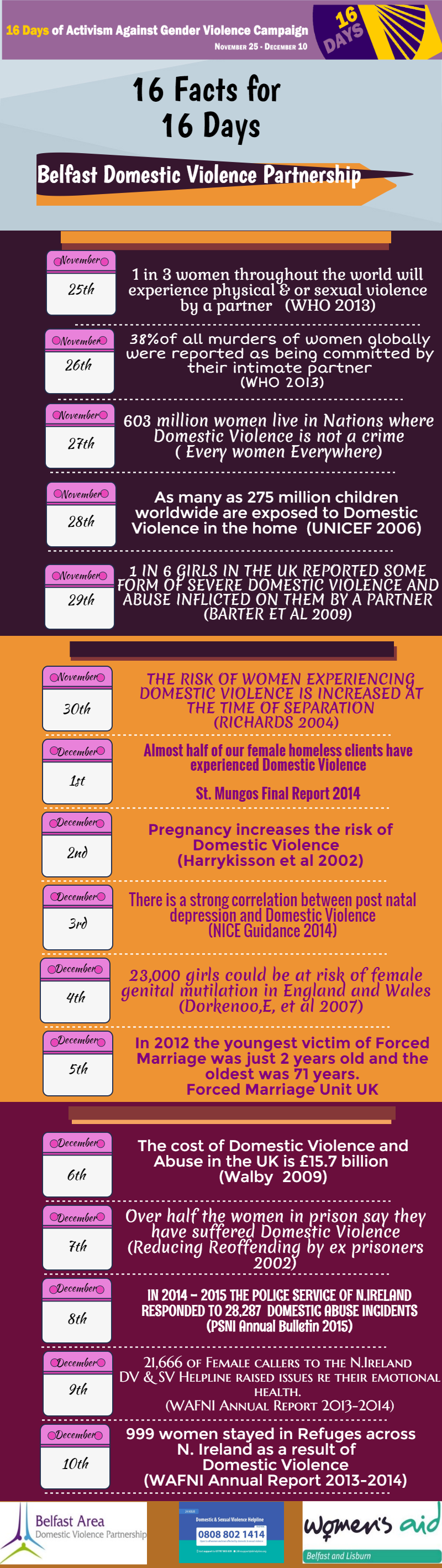
To mark the occasion, the Belfast Domestic Violence Partnership have provided us with ’16 Facts for 16 Days’, an  infographic outlining eye-opening statistics relating to domestic violence worldwide.

Please feel free to share this infographic on your own social media and highlight the importance of the 16 Days of Activism Campaign

BELFAST DVP 16 facts final (2)

If you would ike further information or advice on domestic violence, please feel free to contact us here at life Law NI

16Days