ASSIST NI was set up in 2021 by a partnership consisting of Belfast & Lisburn Women’s Aid, Foyle Family Justice Centre and Men’s Advisory Project.
The service is made up of advocates passionate about supporting victims of domestic and sexual abuse. The focus of the service is to forge and nurture strong working relationships with other services across Northern Ireland to ensure that victims of domestic abuse can access the support they need.
Where are ASSIST NI based?
ASSIST NI advocates are located in police stations across Northern Ireland as well as the Rowan Sexual Assault Referral Centre (the Rowan).
How can ASSIST NI help me?
Advocates at ASSIST NI work closely with the PSNI as well as statutory and voluntary services across NI. If you have been the victim of domestic abuse and have been referred to the service by the PSNI or the Rowan Centre, ASSIST NI can help you in the following ways:-
They can support you with your case and provide information on navigating the criminal justice system.
They can assess your needs and risk, and work with you to create a safety support plan to help you deal with the trauma of any crime committed.
They can provide you with non-judgmental, trauma-informed and victim-centred support.
They can support and guide you, as well as encourage any engagement with the criminal justice system and advocate on your behalf where issues arise.
They can support you to access services.
ASSIST NI supports victims of all genders, adults and young people, victims from the LGBTQ+ community and victims from minority faith or race groups. The service is completely free and is delivered across Northern Ireland to provide trauma-informed support and vital information to all victims of domestic and sexual abuse.
The United Nations designated 15th June as ‘World Elder Abuse Awareness Day’ as an occasion to recognise and highlight the issue of elder abuse in the world and for each country to vocalise its opposition to the abuse and suffering inflicted upon some members of our older generations.
Elder abuse can take many forms though it is widely considered as being “a single or repeated act or lack of appropriate action, occurring within any relationship where there is an expectation of trust, which causes harm or distress to an older person.” As well as financial abuse and neglect, this of course includes physical, emotional verbal and sexual abuse.
Many may view domestic abuse as something that primarily affects younger people or those with children. However just as many older people are affected by domestic abuse. These victims have may have suffered long-term abuse and often face more barriers in their help- seeking process.
Many older victims have lived through a generation where domestic abuse was not recognised or acknowledged, and many have suffered for decades in silence. As a result, these victims may not be aware of the support and services that are available today.
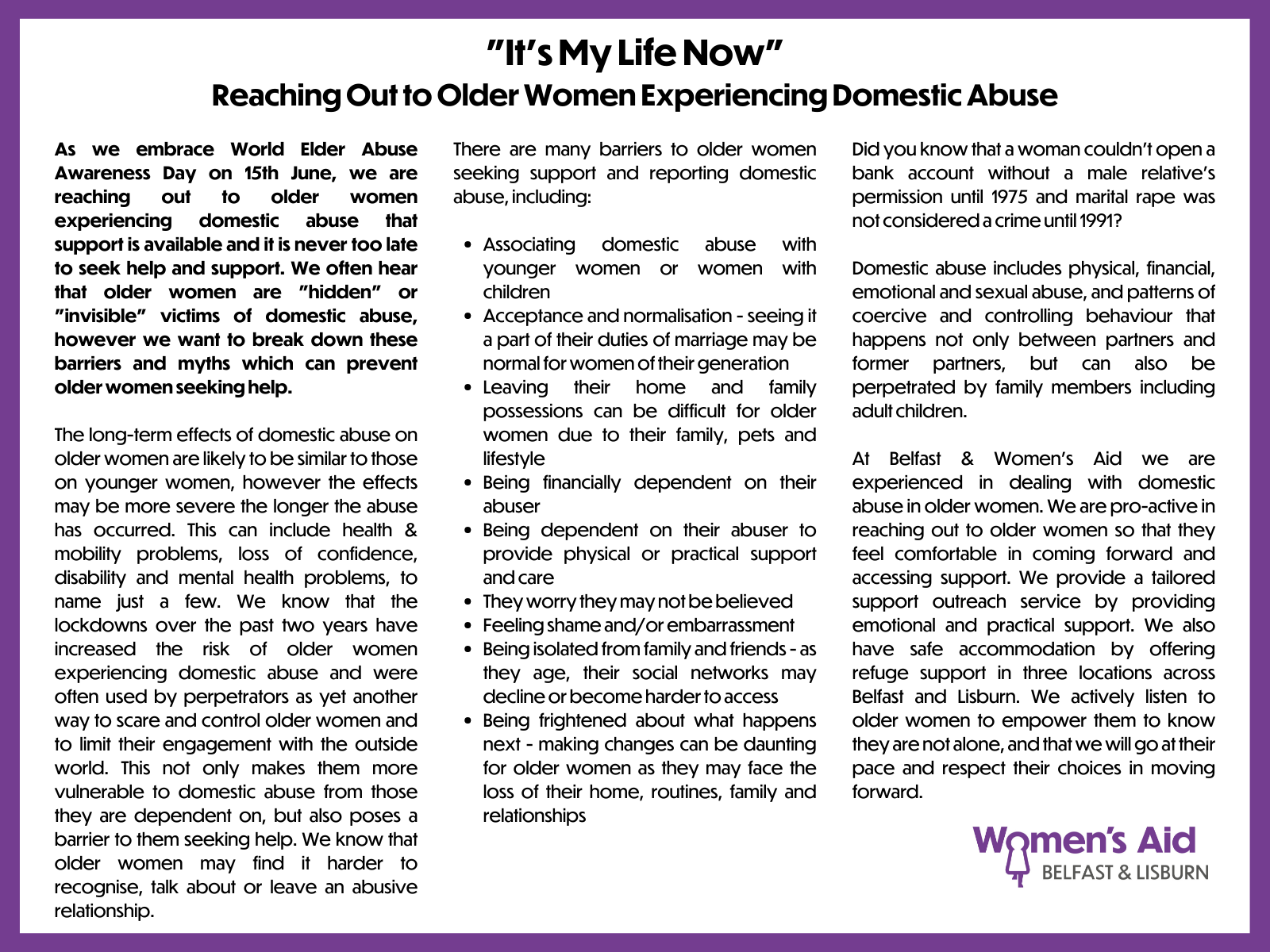
Today, on #WEAAD22, we want to share Women’s Aid Belfast & Lisburn’s message that that support is available for victims of domestic abuse of any age and highlight that it’s never too late to seek help. We have shared below a wonderful article from Women’s Aid Belfast & Lisburn along with ‘Lisa’s Story’.
Should you require any further information on how to protect yourself against domestic abuse, contact us here.
In October 2021, Netflix released fictional 10-part series ‘Maid’ which quickly became one of the streaming site’s most successful shows, with over 67 million people having watched it worldwide to date.
‘Maid’ has received critical acclaim and recognition for its portrayal of issues surrounding parenthood, relationship breakdown, poverty and domestic abuse.
The show’s storyline centres around Alex, the young mother of 2-year-old daughter Maddy, and the struggles she faces when she tries to escape a toxic relationship with Maddy’s father, the abusive and alcoholic Sean. When Alex flees in the middle of the night with Maddy with no money, housing or job, she falls further victim to a system that is broken and that provides her with little to no support. Alex’s steely determination to succeed and to provide a better life for her daughter suffers one setback after another and with each episode, we become emotionally invested in the journey that this young woman takes in trying to regain control of her life and escape the deep-rooted shackles of an emotionally abusive relationship.
Abuse does not have to be physical
Since its premiere, ‘Maid’ has been applauded for not only shining a light and raising awareness on the existence of coercive control and emotional abuse within relationships, but it has also assisted in helping those struggling in emotionally abusive relationships to identify this non-physically violent behaviour and to empower them to seek support.
In the first episode, Alex tells a Social Worker, “Maddy’s dad drinks and he blacks out and punches stuff.” When asked if he punches her or Maddy, she replies; “No, I’m not abused.” When asked whether she wishes to report Sean’s abusive behaviour to the police, Alex replies “and say what? That he didn’t hit me?”
Until recent years it has been a common misconception, not just within society but among victims, that for there to be domestic abuse in a relationship, there needs to be a physically abusive element to that relationship. In Northern Ireland, a landmark piece of legislation will come into force in March 2022 which it is hoped will dispel this myth. The Domestic Abuse and Civil Proceedings Act Northern Ireland 2021 will criminalise a course of abusive behaviour including both physical and non-physical abusive behaviours such as controlling and coercive behaviours.
Coercive control to be punishable by law in NI
One of the most significant aspects of this Act will be the introduction of coercive control as a criminal offence in Northern Ireland. As well as violent or threatening behaviour, the following behaviour will also be punishable by law: –
Making a victim feel dependent on, or subordinate to a perpetrator
Isolating a victim from friends, family members or other sources of social interaction or support
Controlling, regulating or monitoring a victim’s day to day activities
Depriving a victim of, or restricting their freedom of action
Making a victim feel frightened, humiliated, degraded, punished or intimidated.
The legislation also includes provisions which recognise the detrimental effect that domestic abuse can have on children, with enhanced sentences possible in cases where a child is exposed to an incident of domestic abuse. Convictions for the most serious domestic abuse offences will carry a penalty of up to 14 years imprisonment.
‘Maid’ is not an easy watch at times, though it has an important and compelling message. Domestic abuse is often far more complex that the standardized ‘man hits woman’ narrative. The impact that emotional abuse and coercive control can have on a person’s mental health and emotional wellbeing cannot be underestimated. It is hugely positive that the success of this series has allowed some focus to be given to this overlooked thread of abusive behaviour.
The show’s success is timely in the backdrop of Northern Ireland’s own changes to the law in this area. Allowing for criminal prosecutions to arise from non-physical abusive behaviours will go some way to providing further protection to the Alex’s in our society who are trying to break free from abusive relationships.
For further information, advice and support with domestic abuse, please feel free to contact us here.




 Life Law NI
You must be logged in to post a comment.