Unfair Dismissal – Your Questions Answered

you're firedGenerally speaking, in life your main concern is likely to be both your own and your family’s health and wellbeing.  If that’s in place then our next focus tends to be our jobs.

It makes sense – most of us (unfortunately!) spend the majority of our time each week working.   Many of us are lucky enough to enjoy what we do for a living – many of us far from enjoy it! But either way, we all work to pay the bills and have money for the things we want to do in life.

Should things go wrong at work, it often causes worry and stress but, what can you do?  

Worst case scenario: You are sacked by your employer.

You may ask yourself:-

“How will I pay the bills?

”How will I get another job?” 

“How can they do this to me?”

The Jobs and Benefits Office can help with the first two questions but I can help with the third.

If you are asking yourself how they can do this to you, you are also probably thinking that the reason and how you were sacked was unfair. Unfair dismissal is by far the most common query I deal with, but that does not in itself make it straightforward problem.

I have listed some of the most common queries below should you find yourself in this position:-

Do I have the right to claim unfair dismissal?

In order to claim that you were unfairly dismissed, you must firstly have worked for at least one year with your current employer – if you haven’t you unfortunately don’t have the right to make a claim. There are exceptions to this rule (for example, if you feel you were discriminated against) however the general rule is that if you’ve been in your job less than one year, you can’t claim unfair dismissal.

Is my dismissal unfair?

Whether a dismissal is unfair depends on whether the employer had a fair reason to end your employment. If they did have a fair reason to dismiss you, it must also be considered whether the matter was dealt with fairly. If you believe that neither the dismissal nor the way it was dealt with was fair, you may have a claim against your employer.

What is a fair reason for dismissal?

An employer can fairly dismiss an employee for one of the following reasons

  • Capability – it was thought that you were not capable of doing the job
  • Conduct – you have behaved in a way that makes it reasonable for you to be dismissed
  • Redundancy – your job is no longer required
  • Some other substantial reason – for example, business re-organisation.

It is for your employer to show what the reason for the dismissal was.

In addition to showing that the dismissal was fair and reasonable, your employer would also have to show that a fair procedure had been followed.

Is there a time limit for making a claim?

Yes, a claim for unfair dismissal must be brought within 3 months of the date of your dismissal. This is a short and strict time limit! You should therefore seek advice as soon as possible once you have been dismissed as otherwise a potential claim may be out of time and you would be prevented from taking a case against your former employer.

MGavinThis guest blog comes from Mary Gavin, Associate Solicitor in the Employment Law Department of Francis Hanna & Co Solicitors.  If you have any further questions about unfair dismissal or require any further advice on this area, Mary Gavin can be contacted at Francis Hanna & Co Solicitors or by email on mgavin@fhanna.co.uk

As always, we love to hear your thoughts. Please feel free to leave us your comments below.


← Back

Thank you for your response. ✨

Making a Will

Ensuring your wishes come true once you’re gone

We all know the saying, ‘Life is what happens when you’re busy making other plans’. However, with the hustle and bustle of everyday life, it is sometimes difficult to make any plans at all!

Why should I make a Will?

Few people would deny the sense in making a Will, and most of us have at one stage or another considered it, but many of us just don’t get round to the task. Everyday life seems to get in the way and besides, talking about death is a little depressing don’t you think?! Well, there is nothing morbid about making a Will – you can rest assured that it does not hasten the event! In reality, taking a little time to plan how you would wish your assets to be distributed upon death and knowing that your family and children have been properly provided for as per your wishes goes some way to relieving the stresses and worries that many of us may have about death, particularly as we get older. Essentially, by making a Will, you control who inherits and how much of your estate each of your chosen beneficiaries receive.

What if I have not made a Will?

If you have not made a Will, then laws made many years ago (which many people feel are now outdated) direct who the recipients of your estate will be. In today’s world, the patterns of family life are much more diverse and a family may include the following:-

  • Children by more than one partner
  • Step-children
  • Long-term unmarried partners.

If you have not made a Will, these are all complicating factors. For example, if you are unmarried but have a long term partner and child together, your child will inherit your estate if you die without a Will and NOT your partner. Yet most unmarried couples would wish, and expect, that their partner would be first in line to inherit, and their child second. If married, your partner moves to first in line but does not necessarily take all of your estate. Therefore, if you wish to have the reassurance that each and every member of your family is accounted for upon your death, making a Will is the best option for you.

Planning ahead can save you money and heartache, and most importantly will ensure YOU are in control of what happens after your death.

For more information on how to make a Will, please contact Karen or alternatively leave us your comments below. 


← Back

Thank you for your response. ✨

Civil Partnerships


gay cakeFollowing the historic outcome of the Republic of Ireland’s same-sex marriage referendum last week,there have been cries throughout Northern Ireland for equality for same-sex partners on the same level.
England, Scotland and Wales had their first same-sex weddings in 2014 after changes in the law allowed for marriage equality.

However, currently in Northern Ireland, same-sex couples can enter a Civil Partnership but not a legal marriage.

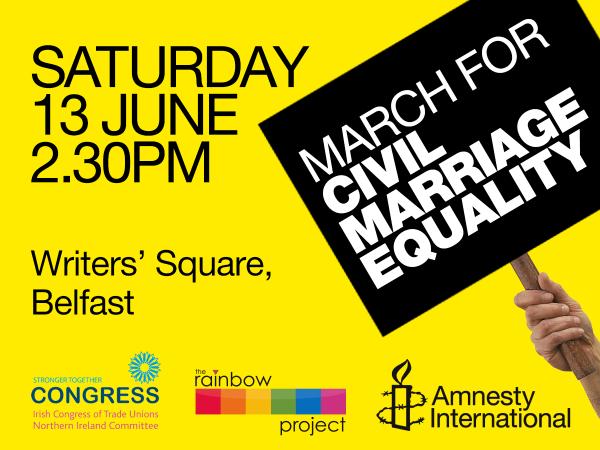
A protest march for equality will take place tomorrow Saturday 13th June in Belfast with campaign groups such as Amnesty International and The Rainbow Project taking part.

So, what are the rights of same-sex couples who enter into a Civil Partnership??

Under the Civil Partnership Act 2004, same-sex couples essentially have the same legal rights as couples who have entered into a civil marriage.

So by entering into a civil partnership, same-sex couples acquire, amongst others, the following legal rights and responsibilities:-

  • The same rights to property as married couples -for example, they may by law have rights over their partner’s property even if they are not on the title deeds
  • They are considered their partner’s legal ‘next of kin’ – for example, if their partner is sick in hospital, they would be entitled to information about their medical treatment
  • The same rights of inheritance as married couples – for example, if their partner died without making a Will, they would be treated as next of kin and are able to inherit from their partner’s Estate.
  • Entitlement to the same inheritance tax exemptions as married couples – ie they can leave their assets upon death to their partner without being hit with inheritance tax.
  • The ability to acquire Parental Responsibility for their partner’s child/children. 
  • The same recognition for immigration and nationality purposes

I have separated from my civil partner – what are my rights??

If civil partners separate, the Civil Partnership Act 2004 allows for property issues, maintenance matters and pension entitlement to all be dealt with in the same way as if the couple were a married couple going through a divorce.

When issues between civil partners can’t be resolved by agreement, the Court can adjudicate on how property and pensions should be divided out or how much maintenance should be paid by one partner to the other – much the same way as if the couple were married and divorcing.

Civil Partnerships & Same- Sex Marriage- what’s the difference??

As civil partnerships offer the same legal treatment to couples as marriage, some people may wonder why there is such a push for same-sex marriage to be legalised in Northern Ireland. Some may ask ‘If you have the same rights as a civil partner, then what’s all the fuss about?’

However, civil partnership is a legal relationship. Opposite sex couples can choose to be married by way of a religious or civil ceremony, whereas entering into a civil partnership is exclusively a civil process.

Many people find that to separate the two in this way is unfair – that whilst same sex couples have legal rights, these are not exactly the same as those given to opposite sex couples. And equal should mean equal right?

It’s an interesting area of discussion and one that it would be interesting to hear from you all on. Please feel free to post your comments and remarks for us below!

samesexmarriagemarch

Women’s Aid: Don’t Silence the Violence

Here is a short film entitled ‘Don’t Silence The Violence’ that was launched by Women’s Aid Antrim, Ballymena, Carrickfergus, Larne and Newtownabbey (ABCLN) last year to raise awareness of domestic violence.  

It’s aim? Quite simply to challenge and break down the barriers that result in women staying in abusive relationships and keeping silent about their abuse. 

Check out our article on domestic abuse for help in getting protection from an abusive partner or contact Claire or Karen for assistance.

← Back

Thank you for your response. ✨

“Mum on the Run” – Parental Child Abduction and the Law

The media today are reporting on the case of a mother, Rebecca Minnock who has gone into hiding with her 3 year old son Ethan after a Judge in an English Court ruled that Ethan should live with his father.

It has been reported that Ethan has lived with his mother since his parents separated in February 2013, but in March 2013 legal proceedings began when his father applied for a Contact Order.

Last month, the Court ruled that Ethan should live with his father after finding that Ms Minnock had made false allegations and obstructed contact between father and son.

Usually, any Court proceedings involving a child are kept confidential. However, following the disappearance of Ethan, the Judge in this case took the unusual step of allowing the facts of this case and the names of the parties and child to be reported by the media in an effort to help find Ethan.

This is not the normal type of child abduction case to make the news. We are more likely to read or hear about media pleas to find children who have been abducted by strangers.

It therefore might surprise you to hear that most child abduction cases in the UK do not involve strangers.   Parental child abduction has become a more common problem in recent years than most of us would like to believe.

 It is unclear whether Ethan has been removed from the UK. It is becoming increasing common for children who are caught up in the relationship disputes of their parents, to be removed from their country they live in to another country by one parent without the consent of the other.

Parental child abduction is an issue which has been addressed by the Courts on an international level.  The 1980 ‘Hague Convention on the Civil Aspects of International Child Abduction’ is an agreement between various countries which aims to ensure the return of an abducted child to the country where he or she normally lives, so that issues of residence (custody) and contact (access) can be decided by the Courts of that country.

It is important for any parent to be aware of their rights under The Hague Convention and the legal proceedings they can issue to ensure the return of their child should the unthinkable happen.

You should seek legal advice as soon as possible if you are worried that:

  • Your child has been abducted from overseas to Northern Ireland
  • Your child has been abducted from Northern Ireland and taken abroad
  • You are being accused of abducting your child.

We are always keen to hear your views on current hot topics such as this so please feel free to leave a comment or contact us about this issue.

Karen